
What you get
AI-traced dermal–epidermal junction, slice by slice
Browse every B-scan in the stack with the predicted DEJ drawn over the image. Where the model is less certain, UNDULIX says so on the trace itself — so reviewers know exactly which regions to check before the figures are used.
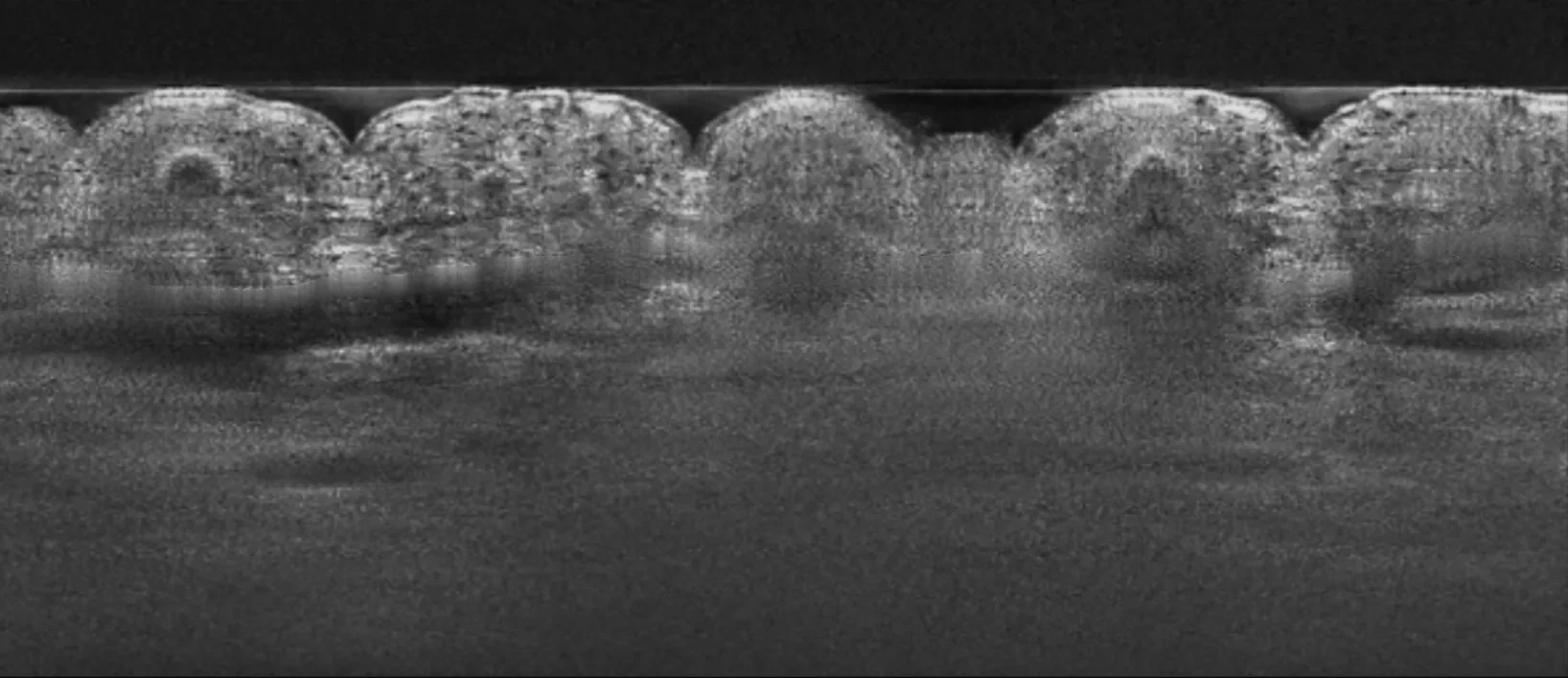
Drag the slider to change frame · point at the scan to read the trace. Frames other than 118 are simulated.
Results · ANALYZED
- DEJ undulation
- 11.6 %
- DEJ roughness (Rq)
- 5.9 µm
- DEJ roughness (Ra)
- 4.8 µm
- Segmentation confidence · REVIEW
- 0.94
1 region below the confidence threshold on this slice.
Built to show what the AI is unsure of

Confidence on every trace
Low-confidence and estimated regions are marked on the image itself.

Difficult sites flagged up front
Hard-to-trace sites are marked before analysis, and their results carry that caveat.

A reviewer stays in the loop
A person accepts or excludes each run, and that decision is recorded.

Every figure keeps its provenance
Model version, settings and confidence are stored with each result.
ⓘ Illustrative interface. All names, model names, figures and study data shown are placeholders.
3D DEJ reconstruction
The junction, rebuilt as a surface you can turn
UNDULIX stacks the traced B-scans into a continuous 3D surface of the dermal–epidermal junction, so papillae and undulation can be inspected as one structure instead of slice by slice.
ⓘ Illustrative surface, generated procedurally to show what the 3D view looks like. It is not reconstructed from a scan and is not a measurement. The 3D generator is in active development, and depth is drawn ×8 for viewing.
Delivered today

DEJ trace with confidence
The junction traced on every slice, with low-confidence regions marked for review.

DEJ metrics
Undulation (%), roughness Rq and Ra (µm) and surface area (mm²), per scan and per region.

3D DEJ surface
Rotate and inspect the junction in the app, and export it as PLY or OBJ.

Report and data
PDF or HTML report, CSV, PNG and JSON, each carrying the run's metadata.
Not yet: epidermal thickness. It needs a trace of the skin surface, which the model doesn't produce yet.

See the Invisible. Measure the Complex.
Start a research partnership
Tell us about your study and whether joint research or a PoC fits better. Our team replies by email.


Available for Windows and macOS
Prefer email? contact@wsoft.space